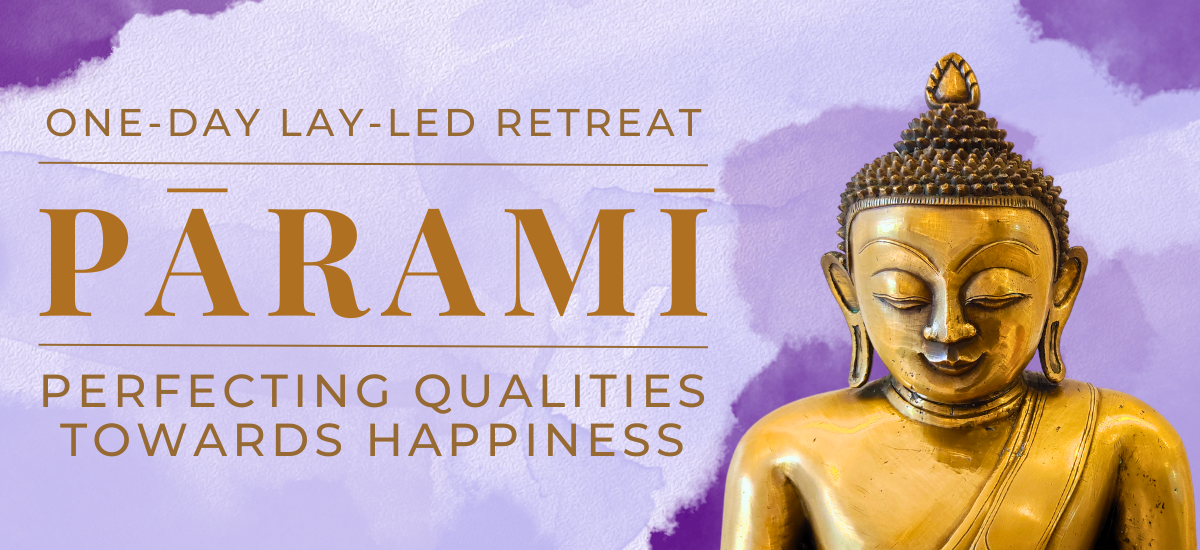

We welcome aspiring Buddhists or those who have a keen interest in exploring the Buddha’s teachings.

Each program is inspired by diverse Buddhist traditions, and the sources used will therefore vary. These may include the early discourses, teachings from different Buddhist traditions, and contemporary interpretations by respected Dharma teachers from around the world.

RESERVE YOUR SLOT

GROUP PRACTICE AND STUDY

Our meditation space is located in a residential area and hosted by one of the initiators in her apartment. We welcome you to join our FREE guided meditation sessions and group practice. However, to abide by the security measures of this residential community and respect the privacy of its residents, we kindly request everyone to book and reserve in advance all sessions that you wish to join.

Please be advised that we will not be able to let you join or come in without a reservation. If you would like to visit the meditation center, kindly book your visit too. Please be advised that we do not encourage walk-in visits. Please book three days prior to your preferred session or visit and bring a valid ID when you come. Thank you for your understanding.

Strengthen your resolve in treading the Buddhist path. Craft your heart with admirable friends.

Please arrive 10 minutes before the session starts.

Schedule:

Tuesday & Thursday | 2:00 pm to 5:00 pm

If you are joining a session with a group, kindly ensure that every individual in the group
has completed the online reservation form.

Why do we cultivate together?

The early discourses remind us that the path is not sustained by isolated effort alone. Spiritual friendship and good companionship are presented as vital supports for the noble path. Practitioners living and training together in harmony show how shared effort strengthens diligence, clarity, harmony, and peace. These teachings suggest that practice matures not only through personal commitment, but also through the support, presence, and encouragement of others.

Practicing with others also softens self-view, because communal life repeatedly asks us to listen, adjust, yield, and act with care rather than from preference or personal ingrained habits alone. In this way, living and practicing together can expose clinging to “I,” “me,” and “mine,” and gradually open insight into anatta, non-self.

This community practice program serves as a weekly reminder for practitioners to contemplate on non-self as the week may have led us to solidify certain self-views. Remembering the teachings of the Buddha with Dharma friends helps us look into our lived experience truthfully yet within a supportive environment.

For Onsite Participation

You are welcome to join us onsite. 

If you are a new practitioner, please register. If you are joining a session with a group, kindly ensure that every individual in the group has completed the online reservation form.

To all onsite participants, please arrive 10 minutes early.

To join online via Zoom

Meeting ID: 841 9228 8645

Passcode: metta

Part of the program is the chanting of The Heart Sutra – this sutra is a short and influential Mahayana scripture that points to emptiness: the insight that all phenomena are empty of fixed, independent essence. Through its famous teaching that “form is emptiness, emptiness is form,” it invites practitioners to see beyond clinging and duality, opening the way to wisdom and compassion in daily life. 

You may read the sutra below:

Security Code:
security code
Please enter the security code:

Submit

THE PRAJNAPARAMITA HEART SUTRA

Avalokitesvara Bodhisattva, while contemplating deeply the prajnaparamita, realized the five aggregates are empty and was liberated from all suffering and hardship. Sariputra, form is not different from emptiness, emptiness is not different from form. Form is emptiness. Emptiness is form. The same is true of feeling, perception, mental formations, and consciousness.

Sariputra, all phenomena are empty. They do not arise or cease, are not defiled or pure, do not increase or decrease. Thus, in emptiness, there are no forms, feelings, perceptions, mental formations, or consciousness.

No eye, ear, nose, tongue, body, or mind; no form, sound, smell, taste, touch or dharmas; no eye consciousness so on unto mind consciousness; no ignorance and extinction of ignorance; even unto no aging and death and no extinction of aging and death; no suffering, cause of suffering, cessation, or path; no wisdom and no attainment. As there is no attainment, bodhisattvas who rely on the prajnaparamita have neither worry nor obstruction. Without worry and obstruction, there is no fear. Away from confusion and delusion, they will ultimately reach nirvana. All the Buddhas of the past, present, and future rely on the prajnaparamita to attain anuttara-samyak-sambodhi.

Thus, know that the prajnaparamita is the great profound mantra, is the illuminating mantra, is the most supreme of all mantras, is the unequalled mantra, able to eliminate all suffering, is true and not false. Thus, proclaim the “Prajnaparamita Mantra,” proclaim the mantra that says:

Gate gate paragate parasamgate bodhi svaha.
take the time to cleanse the mind

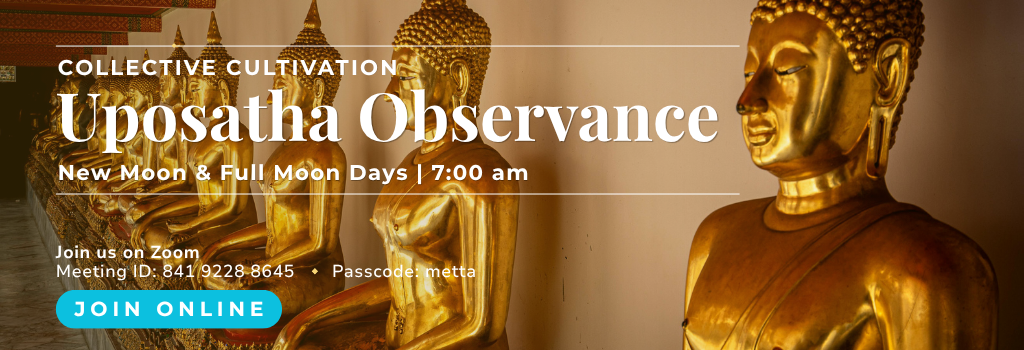
Held every new-moon day and full-moon day of the month, this morning gathering is designed to support practitioners to grow deeper in their practice even within this urban community. 

NEW MOON PROGRAM

Repentance

Eight Precepts

Sitting Meditation

Taking Refuge in the Triple Gem

Dedication of Merits

FULL MOON PROGRAM

Pāli morning chanting

Eight Precepts

Sitting Meditation

Five Recollections

Dhamma Sharing

This program will resume in 2027.

going back to the suttas

“Monks, I do not say that the attainment of gnosis is all at once. Rather, the attainment of gnosis is after gradual training, gradual action, gradual practice. And how is there the attainment of gnosis after gradual training, gradual action, gradual practice? There is the case where, when conviction has arisen, one visits (a teacher). Having visited, one grows close. Having grown close, one lends ear. Having lent ear, one hears the Dhamma. Having heard the Dhamma, one remembers it. Remembering, one penetrates the meaning of the teachings. Penetrating the meaning, one comes to an agreement through pondering the teachings. There being an agreement through pondering the teachings, desire arises. When desire has arisen, one is willing. When one is willing, one contemplates. Having contemplated, one makes an exertion. Having made an exertion, one realizes with the body the ultimate truth and, having penetrated it with discernment, sees it.”

– Kīṭāgiri Sutta  (MN 70)

Our group practice and study program starts with sitting meditation and followed by a study and discussion session. Guide questions are prepared as the basic flow of discussion. 

Links or electronic copy of the reading materials will also be provided. Our sources are taken from translated suttas in the Pali canon and commentaries from current Dhamma teachers and Buddhist scholars.

The goal of this study session is to grasp a deeper understanding of the Buddha’s teaching so we may apply it and practice in our daily life. We are not here for the sake of argumentation. 

Should we wish to ground another person’s point of view, let us do it objectively and with appropriate demeanor. Please remember, our discussion is built on respect.

Respect for a person’s experience, cultural background, and potentials to learn the Dhamma. The initiators of KM will not tolerate any personal attacks on others and will serve as moderators during discussions.

Click the links below to download schedule and materials.

More details will be sent to applicants with successful registration. Register on the calendar if you intend to join the program.

Our meditation space is located in a residential area and hosted by one of the initiators in her apartment. We welcome you to join this program. However, to abide by the security measures of this residential community and respect the privacy of its residents, we kindly request everyone to book and reserve in advance if you wish to join.

Security Code:
security code
Please enter the security code:

Submit

This month's theme:

Program

9:00 am  Registration

9:30 am  Collective Cultivation Program

11:45 am  Lunch & Chores

12:45 pm Walking Meditation

1:30 pm  Sitting Meditation

2:15 pm  Break

2:30 pm  Sitting Meditation

3:00 pm  Dhamma Discussion & Sharing

4:00 pm  End

Lunch contribution: P400

This whole program will include:

  • Meditation
  • Yoga
  • Group Study
  • Community Chores

Calendar of Activities

Subscribe to Kalyana Mitta Meditation Center’s calendar by clicking the “+GoogleCalendar” above and get notified on your devices.

Security Code:
security code
Please enter the security code:

Submit